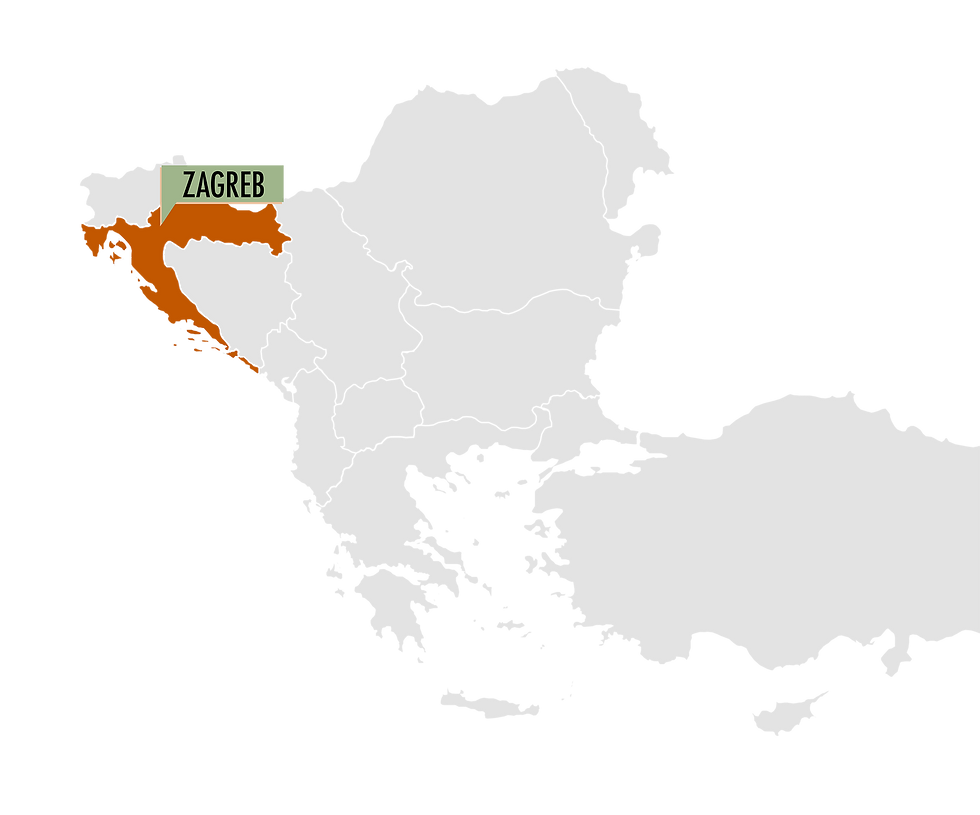
Croatia
With over 1,000 islands, historic old towns, and breathtaking natural scenery, Croatia is one of Europe's most diverse travel destinations. Whether you choose a coastal route, a national park, or a cultural tour, here Mediterranean landscapes blend seamlessly with a rich historical heritage.

Official language
Croatian
Capital city
Zagreb
Form of government
republic
Area
56,542 km²
population
3,829,989
currency
euro
independence
October 8, 1991
telephone area code
+385
UNESCO World Heritage
Dubrovnik Old Town
Split
Plitvice Lakes
Trogir
St. James' Church, Sibenik
Basilica Porec and much more.
Croatia – Always worth a visit
Croatia is a country that has inspired poets, travelers, and thinkers for centuries – and with good reason. It is the story of over 1,000 islands, of coastlines and barren karst landscapes, of stone cities and tranquil monasteries.
A country whose beauty was recognized early on and often celebrated in song:
Cassiodorus wrote of the "heavenly life of the patricians" on its shores. Dante found the epic backdrop for his verses here. And George Bernard Shaw declared the Kornati Islands "paradise created by God on the last day."
This list could go on – but Croatia is more than just a backdrop for quotes. It's a place where the sea meets history, where Mediterranean lightness and Slavic depth coexist.
And that's exactly what makes it one of the most exciting travel destinations in Europe – not loud, not intrusive, but full of substance.
Plitvice & Velebit – Croatia's green heart
Between Zagreb and the Adriatic coast, in the quieter heart of Croatia, lie two of the country's most impressive natural areas: the Plitvice Lakes and the Velebit Mountains. Together, they form a perfect counterpoint to the coast – green, cool, and clear. Plitvice, a UNESCO World Heritage Site and Croatia's most famous national park, is a place not just visited, but experienced.
Sixteen lakes, connected by waterfalls, terraces, and cascades, nestled in a dense beech forest. The water changes color depending on the light – from turquoise to emerald to steel gray. Those who hike here sense that this is more than just scenery. Plitvice has a calming, harmonizing, almost meditative effect.
Completely different, but equally impressive: the Northern Velebit, part of the mountain range of the same name. Here, karst dominates: sharp-edged formations, caves, alpine meadows, and ancient forests. The national park is less well-known, but a real insider tip for hikers and nature lovers – with spectacular views all the way to the coast.
Both parks can be easily combined – or used as a stopover on the way from Zagreb to the south.
Dalmatia – Zadar and the far north of the Adriatic
Zadar is more than just a stopover on the way south – it is the gateway to Dalmatia, and at the same time a region in its own right.
In the north, Croatia begins to reveal its Mediterranean character: the sea becomes more prominent, the air softer, the light brighter. Here, deep blue bays meet dark green pine forests and rocky coastlines – crisscrossed by the white karst formations typical of the region.
Zadar itself is a diverse city. Roman remains, Venetian walls, Byzantine churches, and modern works of art such as the famous Sea Organ or the Greeting to the Sun create an atmosphere that is both historical and contemporary.
The surrounding area offers a wealth of opportunities for day trips, nature excursions, and quiet explorations. Whether along the coast or inland, the region is rich in contrasts – ideal for starting a Croatian holiday or as a tranquil alternative to the more popular hotspots in the south.
Šibenik, Zlarin & Krapanj – Islands, Crafts, Quiet Paths
The region around Šibenik is a stretch of coastline with character. Less staged than Dubrovnik, less bustling than Split – but full of substance.
Šibenik itself is one of the oldest cities on the Adriatic, with a magnificent cathedral made of light-colored stone, a labyrinth of narrow streets in the old town, and several fortresses overlooking the sea. From here, paths lead outwards – to islands, stories, and traditions.
Zlarin is known for its coral fishermen – a craft that has been practiced here for centuries. Time seems to move more slowly on the car-free island.
Krapanj, the flattest inhabited island in the Adriatic, is famous for diving for sea sponges – a quiet tradition that still shapes people's lives today.
Around Šibenik lies an archipelago with over 240 islands, reefs and cliffs – a region for nautically oriented programs, but also for quiet excursions, photo trips or themed tours off the beaten track.
Kornati National Park – Islands like from another world
Just a few nautical miles from the coast, a landscape begins that seems as if it is not quite of this world:
The Kornati National Park – an archipelago of 89 islands, reefs and cliffs, barren, rocky, almost moon-like.
The Kornati islands are not your typical beach resorts. They are wild, uninhabited, and pristine. Anyone who travels here – by boat, kayak, or in a small group – experiences silence, vastness, and a constantly changing interplay of light, wind, and water.
George Bernard Shaw once wrote:
“On the last day of creation, God wanted to put the crown on his work – and created the Kornati islands from tears, stars and breath.”
And even today, one can still feel this grandeur, especially in the early morning hours or shortly before sunset.
The Kornati islands are ideal for nautically inspired trips, day trips from Šibenik or Zadar – or as a quiet, visual counterweight to the more lively coastal resorts.
Dubrovnik – City of Stone, Window to the World
Dubrovnik is a name that evokes expectations – and fulfills them. The walled old town, the light shimmering over the white limestone, the sea beginning right at the city gates – all this has made the city famous.
Dubrovnik was once an independent maritime republic, a center for trade, diplomacy, and culture. Today it is a UNESCO World Heritage Site, a film location, a tourist destination – and at the same time a place that does not live solely on its past.
The old town is compact, walkable, and clearly laid out. Churches, palaces, monasteries, squares – everything is within easy reach. Walking along the walls, you're treated to views of red roofs, the open sea, and a cityscape that has appeared virtually unchanged for centuries. Despite international interest, Dubrovnik has retained its dignity – especially in the early morning or evening hours, once the day-trippers have departed. Then the city feels like what it has always been:
A place of great beauty, built on a harsh history, vibrant and silent at the same time.
Ideal as the crowning finale of a tour or as a standalone city focus – especially in the off-season.


